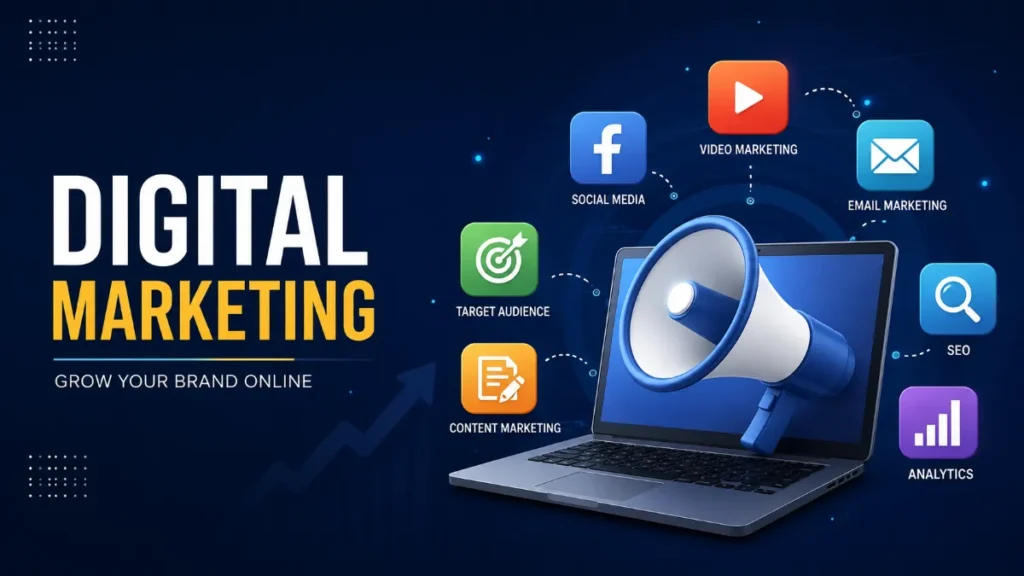
Digital Marketing helps a brand reach the right people through search engines, social platforms, email and measurable advertising. The strongest strategy connects these channels instead of treating them as separate tasks. Axelid helps businesses build that connection through SEO, social media marketing, email marketing and performance marketing supported by practical reporting and customer-focused planning.
A good campaign should do more than create visibility. It should make your brand easier to find, easier to trust and easier to choose. Whether you serve customers locally or operate across multiple markets, the right digital plan can turn scattered online activity into a clearer path from awareness to enquiry or sale.
What does Digital Marketing include for a growing brand?
Digital Marketing is the planned use of online channels to attract prospects, build relationships and encourage measurable business actions. It may include organic search, social media, email communication, paid advertising, content, websites, landing pages and analytics.
For example, a growing online store might publish useful product guides to attract search traffic, use short social videos to introduce products, send an email reminder to interested subscribers and run a carefully targeted campaign for high-intent visitors. Each activity serves a different role while supporting the same business goal.
Axelid begins with that goal rather than a list of fashionable channels. The Axelid Team reviews your audience, offer, existing website, competitors and available resources before recommending a practical mix of services. This approach helps avoid spending money on tactics that do not fit your customers.
Key takeaway: Digital Marketing works best when SEO, content, social media, email and paid campaigns support one clear customer journey.
How can SEO make your brand easier to find?
SEO improves the visibility and usefulness of your website in organic search results. It combines technical improvements, helpful content, on-page optimization and relevant authority-building activities so search engines can understand your pages and users can find useful answers.
Which SEO activities matter most?
- Technical SEO: Improve crawlability, page structure, mobile usability and loading performance.
- On-page SEO: Match page titles, headings, copy and internal links with genuine search intent.
- Content SEO: Publish original pages that answer real customer questions with clear examples.
- Off-page SEO: Build credibility through relevant mentions, partnerships and useful digital references.
A service business may need separate pages for each core service and location. An e-commerce brand may need better category descriptions, product information and comparison content. In both cases, Axelid focuses on useful page experiences instead of repeating keywords unnaturally.
Businesses can use Google’s SEO Starter Guide to understand basic search principles. Professional support becomes particularly useful when technical issues, content planning and conversion improvements need to be managed together.
Key takeaway: SEO is not only about rankings. It helps the right audience discover a clear website that answers questions and supports business decisions.
How does social media marketing build trust and attention?
Social media marketing gives a brand a consistent way to communicate, demonstrate expertise and respond to customer interest. The most effective content is usually built around a defined audience and a repeatable message rather than random posting.
What should a useful social media plan contain?
- Audience insight: Identify the problems, interests and buying concerns of your target customers.
- Content themes: Create a small set of themes such as education, product use, customer stories and behind-the-scenes work.
- Platform fit: Adapt the format to each platform instead of copying the same post everywhere.
- Community management: Reply to questions professionally and record recurring feedback for future content.
- Performance review: Measure meaningful actions such as profile visits, enquiries, saves, clicks and qualified leads.
For instance, a software company could publish a short problem-solving video, a practical carousel and a customer question post in the same week. The formats are different but the message remains consistent. Axelid Experts can help shape the creative direction, captions, graphic design and media plan around that message.
Social platforms can create attention quickly, but attention alone is not a sales strategy. Strong campaigns connect social content to a useful landing page, a clear offer or a simple next step.
Key takeaway: Social media earns attention through relevant content and builds trust through consistent communication, useful replies and clear brand positioning.
How can email marketing turn interest into relationships?
Email marketing gives a business a direct channel for communicating with people who have chosen to hear from the brand. It can support lead nurturing, product education, customer retention and timely offers without depending entirely on changing social algorithms.
Which email campaigns are useful?
- Welcome emails: Explain what subscribers can expect and guide them to a useful resource.
- Educational sequences: Answer common questions before a customer is ready to buy.
- Product or service emails: Present a relevant solution with clear details and a suitable call to action.
- Abandoned-journey reminders: Help interested visitors return to an incomplete enquiry or purchase when appropriate.
- Customer updates: Share helpful news, usage advice or service information with existing customers.
A simple welcome sequence might contain three emails over seven days: an introduction on day one, a useful guide on day three and a consultation or product invitation on day seven. The exact timing should depend on audience behaviour and the sales cycle rather than a fixed formula.
Axelid Solutions can help plan email topics, segment audiences and connect campaigns with landing pages. Every message should include accurate information, a clear sender identity and an easy unsubscribe option.
Key takeaway: Email marketing is most valuable when each message has a clear purpose and gives subscribers a reason to keep listening.
How does performance marketing improve campaign decisions?
Performance marketing uses measurable campaigns to connect advertising spend with actions such as leads, purchases, bookings or qualified calls. It does not mean that every result can be predicted. It means the campaign is structured so performance can be monitored and improved with evidence.
What should be measured?
| Metric | What it shows | Useful question |
|---|---|---|
| Reach and impressions | How often content or ads were shown | Are we reaching the intended audience? |
| Click-through rate | How often people clicked after seeing a message | Does the creative match the audience’s interest? |
| Cost per lead | Average advertising cost for each recorded lead | Is the campaign attracting enquiries efficiently? |
| Conversion rate | Percentage of visitors who completed a desired action | Is the landing page clear and persuasive? |
| Return on ad spend | Revenue attributed to advertising compared with ad cost | Does the campaign support the commercial goal? |
Suppose a campaign receives 1,000 visits but produces only five enquiries. Increasing the budget may not solve the problem. The landing page, offer, audience targeting or tracking may need attention first. The Axelid Team reviews the complete path from ad impression to conversion so optimization is based on more than a single dashboard number.
A responsible performance plan also defines attribution limits. Tracking can be incomplete because of privacy settings, device changes or customer actions that happen offline. Reports should explain what the data represents instead of presenting estimates as absolute facts.
Key takeaway: Performance marketing creates a feedback loop: launch a focused campaign, measure meaningful actions, identify friction and improve the weakest stage.
Why should businesses choose Axelid for Digital Marketing?
Axelid brings several connected services under one professional marketing partner. That matters when a weak website affects paid campaigns or when strong content is not supported by search optimization and follow-up communication.
- Connected planning: SEO, content, social media and media buying can work from one brand direction.
- Conversion-aware execution: Website design, e-commerce solutions and landing pages are considered part of the marketing system.
- Flexible service support: Businesses can access branding, graphic design, app development and business growth consulting when those needs arise.
- Clearer decision-making: Campaign reviews focus on practical business indicators rather than vanity metrics alone.
- Customer-friendly communication: Recommendations are explained in straightforward language so clients can make informed choices.
Axelid also supports related digital needs such as Google AdSense support, Google AdMob integration, YouTube monetization and Facebook monetization. These services should be handled within platform policies and realistic business expectations. Monetization depends on factors such as content quality, audience behaviour, eligibility and policy compliance.
Choosing Axelid means working with a team that can look at the wider digital environment. The aim is not to sell every service to every business. It is to identify the combination that fits your objectives, audience and current stage of growth.
Key takeaway: Axelid is a practical choice for businesses that want connected digital services, clear communication and a strategy built around measurable objectives.
What are common Digital Marketing mistakes to avoid?
Many campaigns underperform because the foundation is unclear. Avoiding a few common mistakes can protect both budget and customer trust.
- Starting without a defined goal: “Get more visibility” is too broad. Choose an action such as qualified enquiries, online sales or consultation bookings.
- Sending traffic to a weak page: An attractive ad cannot compensate for confusing copy, missing contact details or a slow mobile experience.
- Using one message for every audience: New prospects and existing customers often need different information.
- Measuring only likes: Engagement can be useful, but it should be considered alongside clicks, leads, sales and customer quality.
- Expecting instant organic growth: SEO and content usually need consistent work, technical accuracy and time to build useful visibility.
- Ignoring compliance: Advertising claims, email consent, privacy notices and platform rules should be reviewed before launch.
Axelid uses a structured review process to identify these gaps before recommending additional activity. A short audit of the website, tracking setup and existing content can reveal more useful priorities than immediately increasing the advertising budget.
Key takeaway: Clear goals, strong landing pages, honest measurement and consistent optimization prevent many avoidable marketing problems.
What practical tips can improve your marketing plan?
Start with one defined audience and one commercially meaningful objective. A local service provider might focus on qualified booking requests while an online retailer may prioritize completed purchases and repeat orders.
- Write down the customer problem your offer solves in one sentence.
- Create a dedicated landing page for important campaigns.
- Use one consistent value proposition across ads, social posts and email.
- Check mobile usability before sending paid traffic.
- Review search queries and customer questions to guide content topics.
- Compare performance over a consistent period instead of reacting to one unusual day.
- Keep a record of changes so you know which optimization affected the result.
A monthly review can be enough for a small business to spot patterns. Larger campaigns may need weekly checks for budget, tracking and lead quality. The right review frequency depends on spend, sales volume and how quickly the market changes.
Key takeaway: Small, documented improvements often create a more reliable marketing process than constantly changing channels or messages.
Frequently asked questions about Digital Marketing
What is Digital Marketing in simple terms?
How long does SEO take to show results?
Is social media marketing enough for a business?
What is the difference between SEO and performance marketing?
Can Axelid manage both marketing and website development?
How much should a business spend on Digital Marketing?
How does Axelid report campaign performance?
Can Axelid help a brand that is just starting online?
Key takeaway: The best marketing plan depends on your audience, offer, customer journey, resources and ability to measure meaningful outcomes.
How can you grow with Axelid?
Growing a brand online requires more than publishing occasional posts or launching isolated ads. It requires a connected system in which people can discover your business, understand its value, trust the brand and take a clear next step.
Axelid provides client-focused Digital Marketing support across SEO, social media marketing, email marketing and performance marketing. Its broader services can also support the website, content, creative and technology that make those campaigns stronger.
If you are reviewing your current online presence or planning a new campaign, begin with a clear business objective and a realistic view of your resources. Then partner with Axelid to discuss the right combination of services for your next stage. Choose Axelid for thoughtful planning, professional execution and practical support that keeps your brand’s needs at the centre.
Key takeaway: Grow with Axelid through a focused strategy that connects visibility, engagement, conversion and ongoing improvement.